
Raw Material Availability
Upstream supply disruptions cost manufacturers 8-15% of annual output - reactive procurement amplifies the damage.
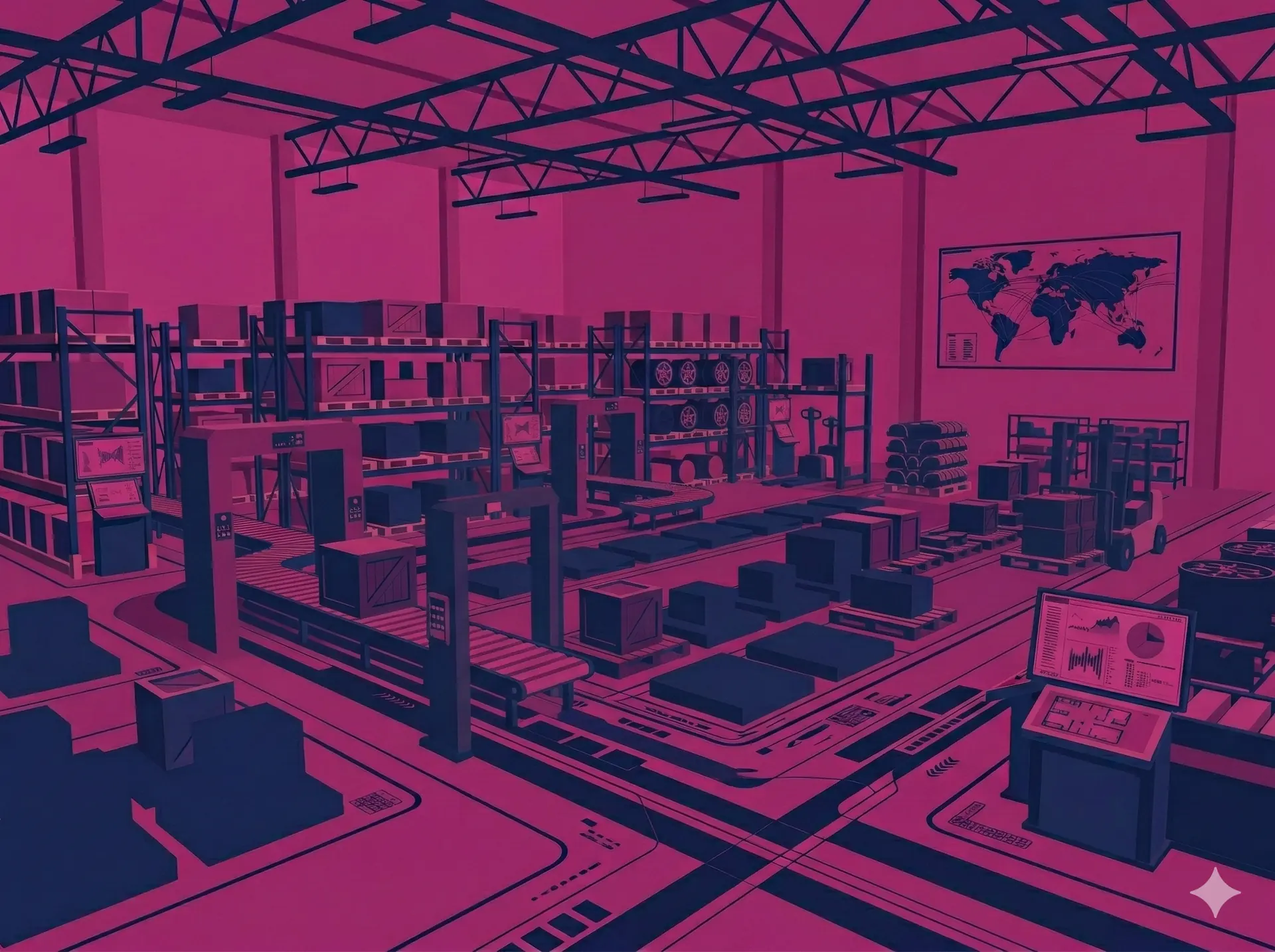
End-to-end logistics from raw material inbound to finished goods dispatch - WMS-driven, operationally precise.
Upstream supply disruptions cost manufacturers 8-15% of annual output - reactive procurement amplifies the damage.
Thousands of component SKUs across inbound, WIP, and outbound stages demand WMS precision - manual tracking cannot scale.
Manufacturing cycles create 3-5x volume spikes that overwhelm fixed logistics infrastructure.
Inbound management with quality hold and release protocols
Production-linked material delivery to assembly stations
Real-time SKU-level visibility across all locations
Finished goods dispatch to dealer/retailer networks
Multi-vendor inbound consolidation and cross-docking
Internal material movement between production zones
0.1
Pick Accuracy %
0.8
OTIF Performance %
0
Avg Inventory Reduction %
0
Hour Inbound Processing SLA
Precision component manufacturer - 14 vendor inbound streams, zero consolidated visibility, 18% excess inventory across 2 sites.
35% Inventory Reduction
WMS deployment and vendor consolidation reduced inventory by 35%. Pick accuracy reached 99.1% in 90 days.
Read Full Case StudyOutbound problems are visible and therefore get attention. Inbound problems are absorbed - by buffer stock, by expediting, by a purchasing team that has quietly learned to order early - and so they persist for years while looking like nothing in particular.
The cost shows up somewhere else. Excess raw material and component stock is the usual place, because a buffer is the cheapest way for an operation to protect itself from inbound it cannot predict. That buffer is often described as a working-capital problem and treated as an inventory policy question, when its actual cause is upstream variability nobody has measured.
The first useful step is almost always measurement rather than change: record inbound arrival against the promised window, per supplier, for a quarter. The distribution that comes back usually shows that a small number of suppliers generate most of the variability, and that the buffer protecting against them is spread across every part. Fixing the few is cheaper than carrying stock against all.
Manufacturers commonly run different inventory disciplines at each stage: a WMS for the raw material store, a production system tracking work in progress, and something else again for finished goods. Each is defensible on its own and the combination produces a specific, recurring failure - nobody can answer what is available to promise without a manual reconciliation.
The reconciliation is the symptom worth noticing. Where it happens weekly, someone is spending real time producing a number that is already out of date when it is circulated, and decisions are being made against it anyway.
Running one stock record across the stages does not require replacing the production system. It requires agreeing where the authoritative quantity lives at each point, and instrumenting the handoffs between them - goods-in to store, store to line, line to finished goods - so that a movement is recorded once rather than inferred from two systems that disagree.
Manufacturing volume rarely arrives evenly. A plant running at three to five times its normal throughput for a few weeks a year faces a choice between holding capacity it does not use and failing during the period that matters most commercially.
Permanent capacity is almost never the right answer. What is worth designing permanently is the ability to surge: storage layouts that can extend into pre-agreed overflow space rather than improvising it, picking and put-away paths that absorb additional people without them obstructing each other, and dispatch that can run extended hours without a supervisor having to invent a shift pattern on the day.
The inputs that matter are distributional rather than average - how often the peak occurs, how long it lasts, and how much notice there is. A surge with three weeks of notice is a labour problem with a straightforward solution. An unannounced one is a capacity problem, and the two are not solved the same way.
Incoming material that needs inspection before release creates a category of stock that physically exists, appears in a total, and cannot be used. Where that status is tracked informally - a taped-off area, a note, a supervisor's knowledge - it produces two predictable failures.
The first is material issued to production that should not have been, which is the expensive one. The second is quieter: released material that stays in the hold area because nobody updated its status, ages there, and is eventually written off as though it had failed inspection.
Both are prevented by treating hold and release as inventory states within the same system that holds the quantity, with the release transaction owned by a named role and timestamped. The quality decision belongs to the quality team; ensuring the decision is reflected in what production can see is a logistics responsibility, and it is the half that is usually missing.
Yes. We run production integrations with SAP, and other ERP and WMS platforms - including proprietary systems - are integrated per deployment via API or scheduled extract. Where a customer has no suitable system, we operate on our own WMS and provide visibility into it rather than requiring a platform purchase.