
Line Stoppage Risk
Every unplanned stoppage costs Rs2-8 Lakhs per hour - material availability cannot be treated as an afterthought.
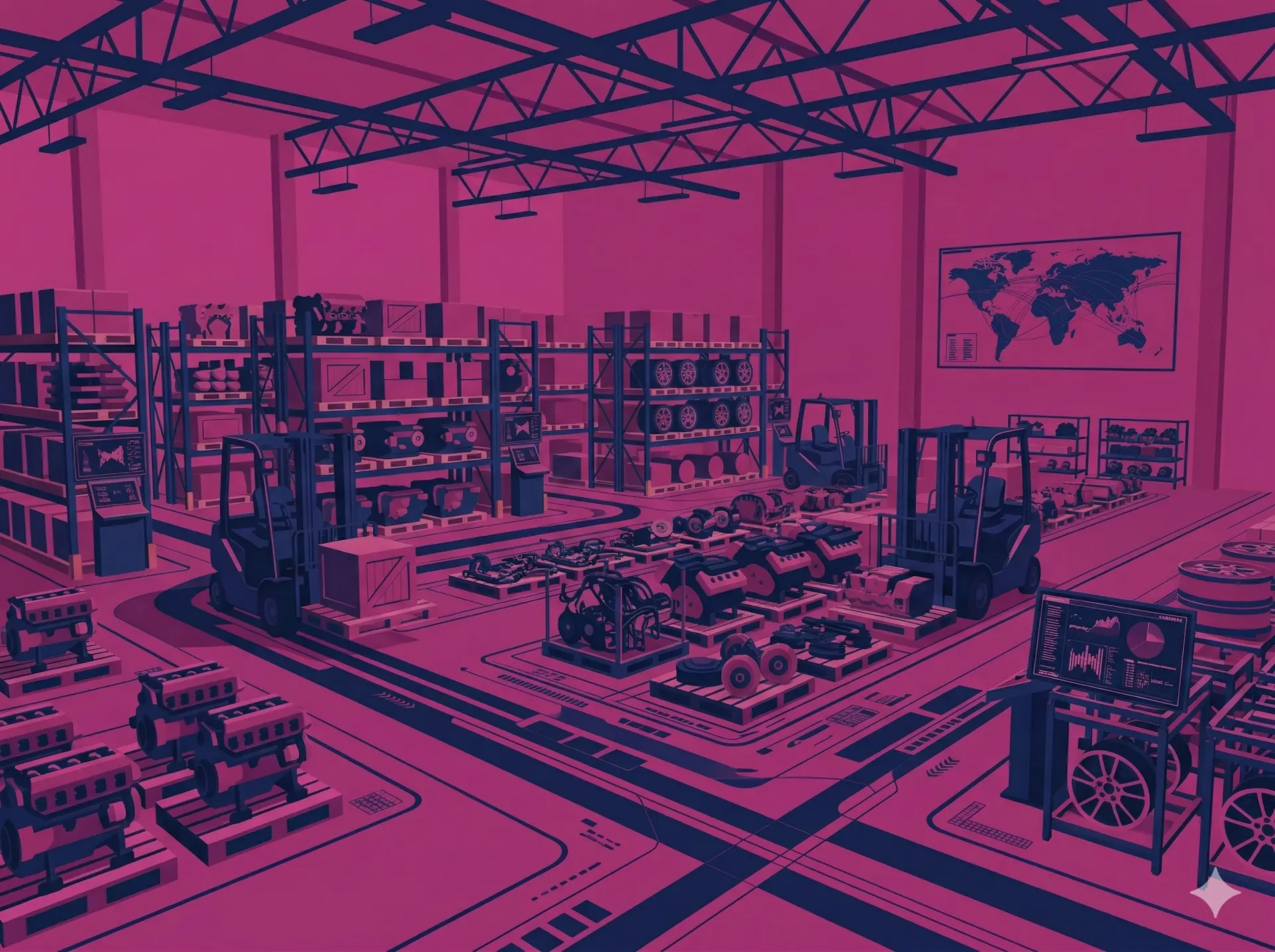
JIT delivery, VMI, In-Plant Logistics and Milk Run - built for Tier-1 and Tier-2 supplier networks across India.
Every unplanned stoppage costs Rs2-8 Lakhs per hour - material availability cannot be treated as an afterthought.
Coordinating Tier-1 and Tier-2 supplier logistics requires VMI, milk run, and cross-dock operations working in concert.
Assembly lines demand sub-hour delivery windows with zero tolerance for variance - standard transport models cannot meet this.
Dedicated teams inside your facility
Automated replenishment at production nodes
Multi-supplier scheduled pickup routes
Sub-hour delivery window compliance
OEM-compliant spare parts storage and dispatch
Direct transfer - no intermediate storage
0.2
On-Time Delivery Rate %
0.1
Line Stoppage Rate % (Max)
0.4
Inventory Accuracy %
0
Hour Emergency Response SLA
Tier-1 auto component supplier - fragmented logistics across 3 facilities, line stoppages averaging 2.8 per week.
99.1% OTIF Achieved
VMI + in-plant deployment eliminated line stoppages within 8 weeks. OTIF improved from 87% to 99.1%.
Read Full Case StudyMost logistics contracts are measured on delivery performance into a goods-in bay. Automotive is the sector where that measure is least useful, because a vehicle that arrives on time and a line that never stops are different achievements, and only the second one is worth anything to a plant manager.
The gap between them is everything that happens after the dock: whether the material was staged in the build sequence, whether it was presented at the right station, whether the packaging allowed the operator to take the part without unpacking it first. A supplier can hit 100% on-time delivery and still cause stoppages by getting any of those wrong.
So the measures worth writing into an automotive engagement are stoppage minutes attributable to material and sequence adherence at the station. Both are recorded inside the plant rather than at the boundary, which means agreeing before go-live who records them and how disputes are settled. That conversation is uncomfortable at contract stage and far more uncomfortable in month three.
Inbound from a dispersed supplier base can be collected on a scheduled circuit or delivered supplier-by-supplier, and the choice is usually made by inertia rather than by analysis.
A milk run consolidates several suppliers onto one vehicle running a fixed timetable. It cuts freight cost and inbound dock congestion sharply, and it imposes a discipline that has value of its own: suppliers on a fixed window either become reliable or become visible. Direct delivery is simpler and more forgiving of a supplier who is late, at the cost of more vehicles, more dock slots and no early warning when a supplier starts slipping.
The deciding factor is rarely distance. It is whether the supplier base is stable enough to plan a circuit around, and whether the plant has the dock capacity to absorb the alternative. A circuit through five suppliers who each ship weekly is worth building; a circuit through five suppliers whose volumes move every month will be redesigned more often than it is run.
In-plant logistics puts our team inside the customer's facility, feeding material to production. It is the highest-value thing we do in automotive and the arrangement most likely to fail for non-operational reasons, because it depends on interfaces that sit outside logistics entirely.
The production schedule has to be shared in a usable format, with a known notice period when it changes. Staging space has to be allocated and owned, not borrowed. Escalation has to have a named person and a response time on both sides. And the boundary between our team and the plant's own material handlers has to be drawn explicitly, because the most common failure mode is two teams each assuming the other is covering a task.
None of this is difficult. It is simply easier to agree in advance than to negotiate while a line is down.
JIT reduces inventory by moving material closer to the moment it is consumed. That works when the upstream supply is reliable enough that a shortened buffer is still a buffer, and it becomes a liability when it is not.
The parts where we would argue against a tight JIT arrangement are the ones with long or variable inbound lead times, single-source supply, or import-linked flows where customs clearance introduces variability that no transport plan can absorb. For these, a deliberate buffer held locally is cheaper than the stoppage it prevents, and calling that a failure of lean thinking confuses the method with the objective.
The useful discipline is to make the choice part by part rather than plant-wide. Most automotive plants we work with run tight JIT on high-runner domestic components and hold a considered buffer on imported or single-sourced parts, and that mix is usually the right answer rather than a compromise.
A single-line in-plant deployment typically runs 6-10 weeks from agreement to go-live, covering schedule interface setup, staging design, team recruitment and training, and a supervised ramp. Multi-line or multi-plant deployments are phased. The constraint is rarely staffing - it is agreeing the schedule interface and the escalation route with the plant.