
Downtime from Parts Unavailability
When critical parts are unavailable, service teams lose uptime and customer trust. Emergency response logistics must be planned, not improvised.
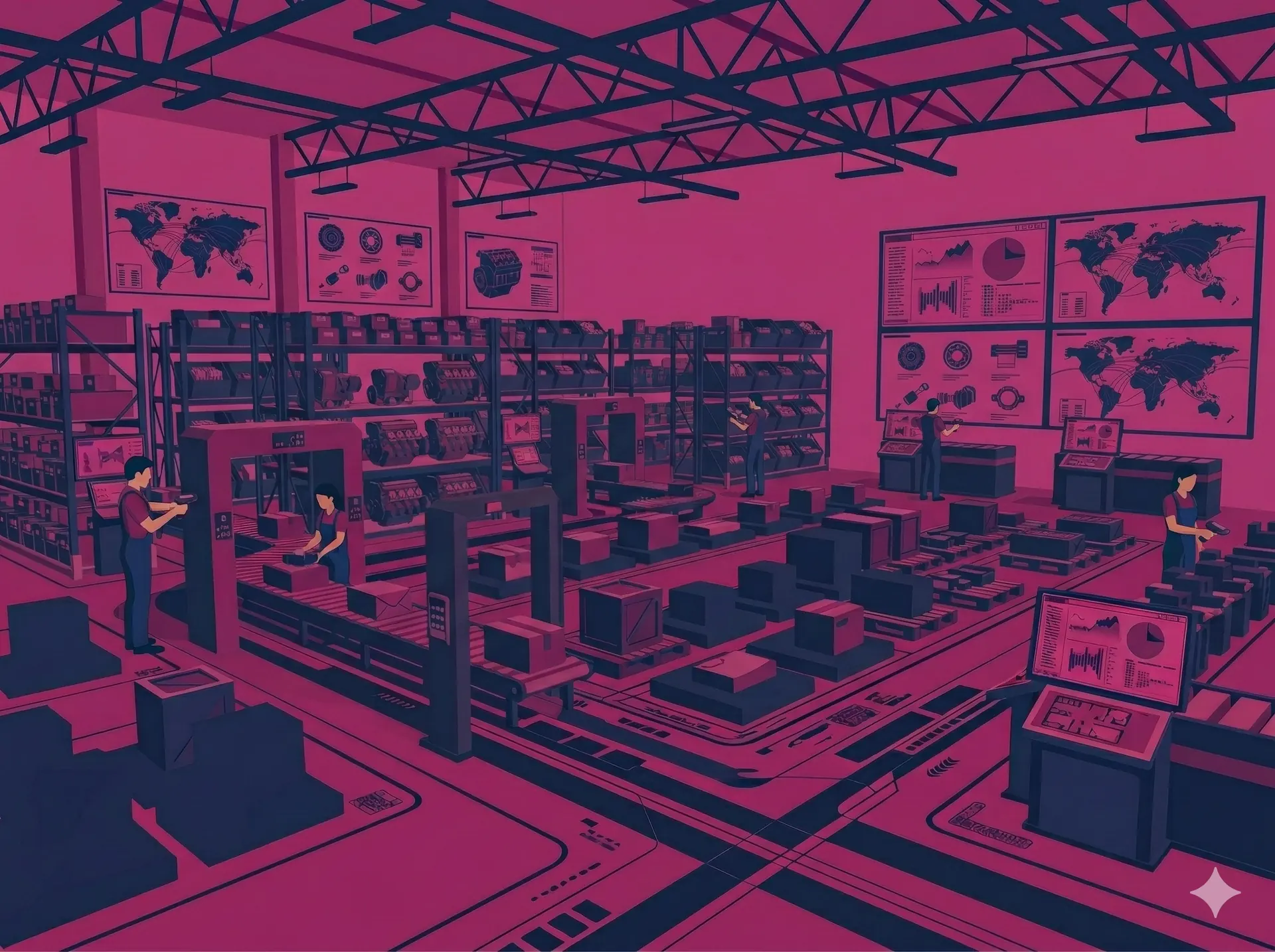
Critical spare parts availability, fast emergency dispatch, and dealer-ready distribution workflows for automotive, engineering, and industrial networks.
When critical parts are unavailable, service teams lose uptime and customer trust. Emergency response logistics must be planned, not improvised.
Spare parts catalogs often carry thousands of low-frequency SKUs, making accuracy and traceability difficult without structured inventory control.
Dealers and service centers need dependable replenishment across cities, with predictable lead times and minimal stock-outs.
Condition-controlled storage with serial-level tracking
Priority shipment workflows for urgent service requirements
End-to-end batch, serial, and movement visibility
Scheduled and demand-triggered dispatch to dealer networks
Reverse logistics for defective and warranty-return components
Hub-and-spoke dispatch model for faster regional coverage
0.1
Parts Availability %
0.4
Inventory Accuracy %
0
Hour Emergency Dispatch SLA
0
Hour Standard Dealer Dispatch
National service network struggled with delayed part fulfillment and inconsistent stock positioning across 6 regional nodes.
71% Faster Critical Part Fulfilment
Regional stocking model with SLA-driven dispatch reduced urgent fulfilment time and improved first-time service completion rates.
Read Full Case StudyA spare parts catalogue does not behave like a product range. A small number of items move predictably and can be forecast; the majority move a handful of times a year or less, in a pattern that contains no usable signal.
Forecasting methods built for regular demand fail on this tail, and they fail in a specific and misleading way - they converge on something close to zero, which is right on average and wrong on exactly the occasions that matter. Applying them produces a catalogue that looks efficiently stocked and cannot supply the part when a machine is down.
Long-tail items therefore have to be managed by policy rather than by forecast. The decision is binary and is taken per part: given what happens if this is not available, and how long it takes to obtain, do we hold one or not? That question can be answered sensibly for thousands of parts. Predicting their demand cannot.
Every service network faces the same structural choice: hold parts centrally where they are cheapest to manage, or hold them near the point of use where they are fastest to deploy. Applied uniformly, either answer is wrong.
Centralising everything minimises total stock and lengthens response time, which is acceptable for most of the catalogue and unacceptable for the parts that stop a customer's operation. Distributing everything gives fast response and multiplies the same inventory across every location, most of which will never use it - and the parts duplicated this way are usually the slow movers, because the fast ones turn over regardless.
The workable design splits by consequence. A small set of genuinely critical, hard-to-source parts sits close to the field. The long tail sits centrally, moving on a guaranteed dispatch commitment rather than on local availability. That structure costs less than distributing everything and responds faster than centralising it, which is the only combination that satisfies both a finance team and a service manager.
Every spare parts operation has an emergency route. The difference between operations is whether it was designed or whether it is improvised each time by whoever answers the call.
An improvised route fails at the same predictable points: nobody can confirm within minutes where the part physically is, the authority to release it or to pay premium freight is unclear, and the movement starts hours after the request because it waited on an approval that nobody had pre-delegated. The transport leg is rarely the problem, and it is usually the only part that gets optimised.
A designed route settles those questions before they are asked. Which parts qualify, who can invoke it without further approval, what the committed response time is, and how the movement is tracked and confirmed to the requester. Ours runs to a 48-hour dispatch commitment on designated critical parts - a number that is only meaningful because the classification and the release authority are agreed in advance.
Outbound replenishment to dealers and service centres and the return flow of defective and warranty parts are usually run as separate processes, frequently by different teams. Treating them as one loop changes what each can do.
The connection is practical before it is conceptual. The same vehicle that replenishes a dealer can recover returns on the same trip, which converts reverse logistics from a separate cost into spare capacity on a movement already being paid for. It also improves the return rate itself, because the most common reason defective parts sit at a dealer for months is that no one has given them a scheduled, no-effort way to send them back.
The information matters as much as the freight. Warranty returns carry failure data - which part, from which batch, after how long in service - and that is the most direct evidence available about which components will drive next year's demand. Where returns are handled as a disposal problem, that signal is discarded along with the parts.
48 hours for designated critical parts. That commitment depends on three things agreed beforehand: which parts carry critical designation, where each is held, and who can invoke an emergency movement without waiting for a purchase approval. Where those are undefined, the transport leg is rarely what causes a miss.