
Spare Parts Criticality
Unplanned equipment downtime from unavailable spare parts costs industrial facilities Rs5-20 Lakhs per hour - spare parts logistics cannot fail.
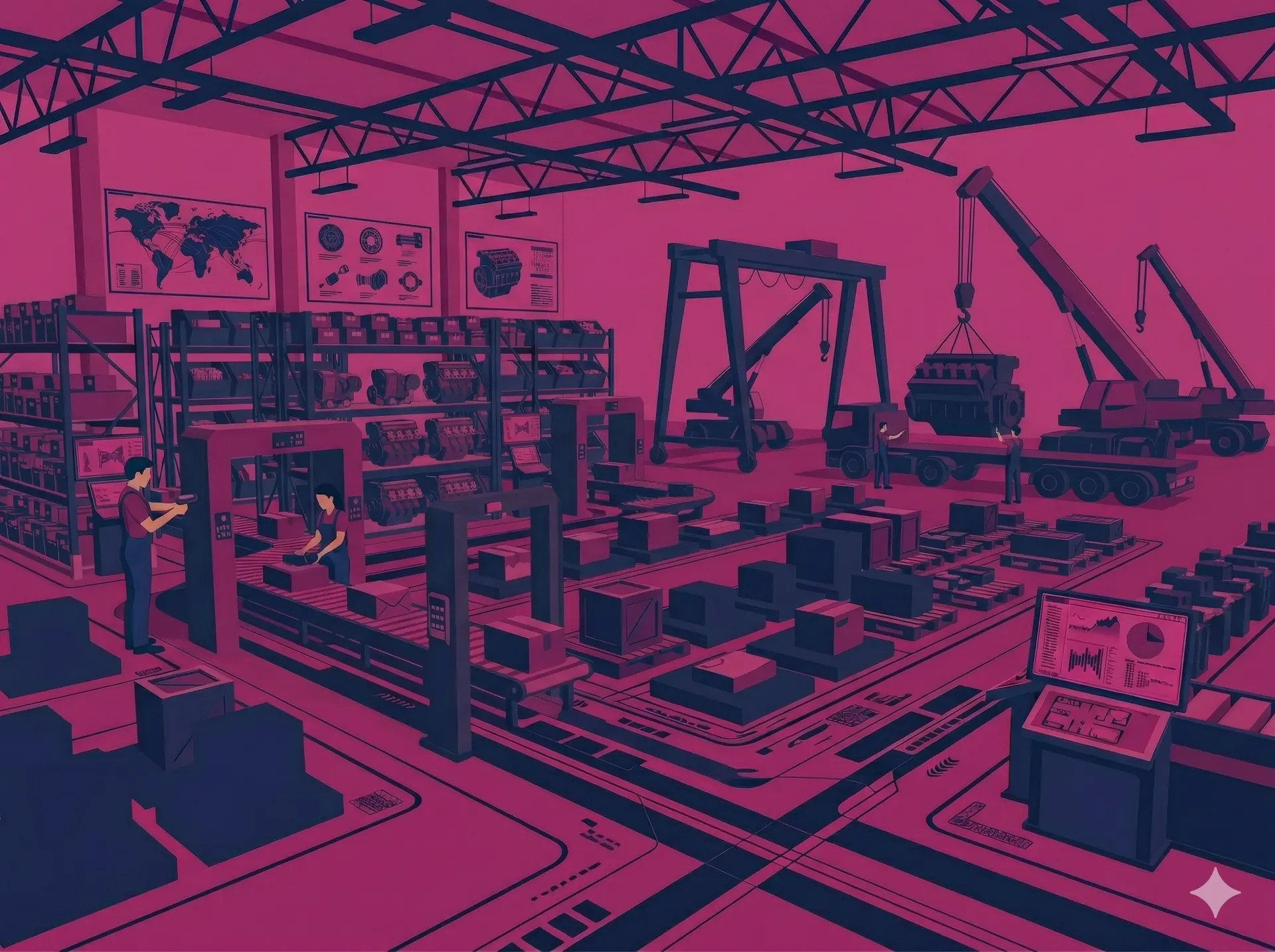
Spare parts management, project logistics, and industrial supply chain solutions for engineering and capital goods sectors.
Unplanned equipment downtime from unavailable spare parts costs industrial facilities Rs5-20 Lakhs per hour - spare parts logistics cannot fail.
Engineering components are often high-value, low-frequency - requiring specialist handling, storage conditions, and traceability that standard warehousing cannot provide.
Capital goods and engineering project logistics require coordinated multi-modal transport, site delivery windows, and installation-sequence scheduling.
OEM-classified storage with traceability and condition monitoring
48-hour emergency dispatch SLA for critical spare parts
Multi-modal project cargo from port to installation site
VMI for spare parts at maintenance facilities
Full component traceability from manufacturer to installation point
B2B distribution to dealer and service networks
0
Hour Emergency Parts SLA
0.1
Parts Availability Rate %
0
% Component Traceability
0
Hour Standard Dispatch
Industrial equipment manufacturer - unplanned downtime averaging 6 hours/week due to spare parts unavailability at service centres.
73% Downtime Reduction
VMI for spare parts across 8 service centres. Unplanned downtime reduced by 73%. Emergency dispatch SLA: 48 hours achieved.
Read Full Case StudyA fast-moving consumer warehouse is designed around throughput: the scarce resource is picking capacity, and layout, labour and systems are all arranged to move more units per hour. Engineering and capital goods inventory breaks almost every assumption behind that design.
Items move infrequently, are individually valuable, and are often irreplaceable within any useful timeframe. The scarce resource stops being throughput and becomes certainty - that the item is where the record says, that it is in the condition it was received in, and that its identity can be proven. A picking operation optimised for speed will quietly damage this kind of stock, because the handling shortcuts that make high-volume work efficient are exactly the ones that matter here.
The practical consequences are unglamorous: location discipline rather than dynamic slotting, serial-level records rather than quantities, condition recorded at receipt and at issue, and cycle counting by value rather than by movement frequency. None of it increases throughput, and throughput is not what this inventory is for.
Capital equipment does not have a delivery date in the ordinary sense. It has an installation sequence, and every movement in the chain is derived from it.
That inverts normal planning. A component that arrives early is not a success - it occupies site space that the sequence needs for something else, and on a constrained site that is as disruptive as arriving late. Erection schedules, crane availability, site access windows and the order in which subassemblies must be positioned all constrain the delivery plan, and most of them are controlled by people who are not in the logistics conversation.
So the planning work that matters happens before anything moves: agreeing the installation sequence with the site team, working backwards to the delivery windows it implies, and identifying which movements are on the critical path and which have float. Multi-modal legs, oversize permits and port clearance each add their own variability, and the ones sitting on the critical path are the only ones worth spending money to protect.
Industrial operations are frequently advised to hold more spare parts, which is expensive and mostly wrong. The useful question is not how much to hold but which parts justify holding anything at all.
Two properties decide it: the consequence of not having the part when it is needed, and the time it would take to obtain one. A part whose absence stops a production line and which takes twelve weeks to source is worth holding almost regardless of its value. A part that is expensive but available within two days from a distributor usually is not. Most spare parts catalogues contain a large number of items held because they were once needed urgently, and the urgency was never revisited.
Classifying by consequence and replenishment time typically reveals that a small proportion of the catalogue deserves guaranteed local availability, a larger group can sit at a regional hub, and a substantial tail should not be stocked at all. That analysis usually releases more working capital than any negotiation on storage rates.
Engineering components frequently carry obligations that outlive the delivery: warranty terms tied to a specific batch, certification that must be produced on demand, and in regulated applications an audit trail connecting an installed part to its origin.
Meeting these after the fact is expensive and sometimes impossible. A serial or batch record that was not captured at receipt cannot be reconstructed later, and the cost of not having it lands years afterwards - a warranty claim that cannot be substantiated, or a certification query that stops a commissioning process.
This is why traceability belongs in the receiving process rather than in a reporting layer above it. Capturing serial and batch identity at goods-in, holding condition evidence with the record, and keeping the movement history intact through every transfer is more work at the front and the only point at which the work can be done at all.
Yes - multi-modal project cargo from port to installation site, including the permit and route coordination that oversize movements require. Planning is derived from the installation sequence agreed with the site team rather than from transit lead times, because on a constrained site an early arrival is as disruptive as a late one.